
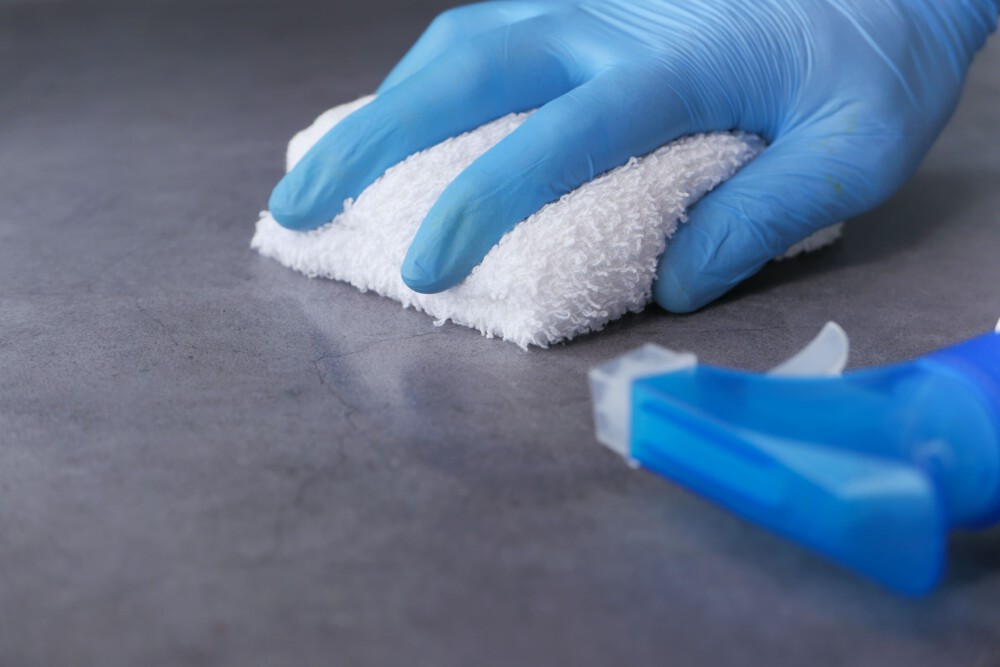
EN 16777 establishes a quantitative method for evaluating the virucidal activity of chemical disinfectants used on non-porous surfaces in the medical area, without mechanical action. It is a phase 2, step 2 test designed to more closely reproduce practical conditions of use than tests performed only in suspension.
In Spain, the standard is published as UNE-EN 16777:2019, identical to the European standard EN 16777:2018 and currently in force. Its full title specifically refers to the quantitative non-porous surface test without mechanical action for evaluating the virucidal activity of chemical disinfectants used in the medical area.
Understanding this difference between a suspension test and a test on a dry surface is important for both manufacturers and laboratories working on disinfectant efficacy evaluation.
What Does EN 16777 Evaluate?
EN 16777 evaluates whether a disinfectant can sufficiently reduce the infectivity of a virus when it has been deposited and dried on a non-porous surface.
This represents a different situation from a suspension test.
In a suspension test, the microorganism and the disinfectant product are mixed directly in a liquid medium. In EN 16777, however, the virus is deposited on a carrier, allowed to dry and the product is then applied.
Therefore, the test introduces factors that can significantly affect disinfectant efficacy, such as:
- Drying of the virus on the surface.
- Interaction between the product and the contaminated material.
- The presence of interfering substances.
- The actual contact time.
- The ability of the product to act on contamination already fixed to a surface.
This design makes it possible to evaluate disinfectant performance under conditions closer to its intended use on surfaces.
EN 16777 Is A Phase 2, Step 2 Test
European standards for evaluating disinfectants and antiseptics use different test phases.
Phase 2, step 1 tests evaluate antimicrobial activity in suspension under controlled conditions, following the applicable method.
Phase 2, step 2 tests, such as EN 16777, introduce application conditions that are closer to practical use.
In this case, the key difference is that the microorganism is not kept suspended in a liquid, but is dried on a surface.
This is particularly relevant because a product that demonstrates virucidal activity in suspension does not necessarily behave in exactly the same way when acting on a contaminated surface.
What Is The Scope Of EN 16777?
EN 16777 is specifically intended for products used for the disinfection of non-porous surfaces in the medical area, including surfaces of certain medical devices when the procedure does not involve mechanical action.
This may include surfaces in hospitals, medical practices, healthcare facilities or other environments where disinfection is medically indicated.
It should not be confused with other standards intended for:
- Veterinary areas.
- The food industry.
- Industrial areas.
- Other specific disinfection applications.
Each field has its own standards and test conditions.
This distinction is important because not all biocidal efficacy standards can be used interchangeably for every claim or field of use.
Why Does The Standard Specify “Without Mechanical Action”?
One of the most important aspects of the title of EN 16777 is precisely the expression “without mechanical action”.
During the test, the virucidal effect is attributed to the chemical action of the product and the conditions established by the method, not to wiping, scrubbing or physical removal.
This difference is particularly important when evaluating products whose real-life performance also depends on mechanical action, such as certain disinfectant wipes.
The efficacy of a system combining a product, substrate and mechanical movement may depend on additional variables, such as:
- The amount of product released.
- The wipe material.
- The pressure applied.
- The area of the treated surface.
- Removal or transfer of the microorganism.
For this reason, EN 16777 evaluates activity on a surface without reproducing mechanical cleaning action.
How Is The EN 16777 Test Performed?
Although the complete procedure includes specific controls and technical requirements, the general principle of the test can be summarised in several stages.
First, a viral suspension is prepared together with the appropriate interfering substance.
A defined amount of this preparation is then deposited on a non-porous carrier, usually stainless steel, and allowed to dry.
Once the contamination has dried, the disinfectant product is applied at the selected concentration and for the selected contact time.
After the specified time has elapsed, the activity of the product is stopped and the remaining virus is recovered.
Finally, residual viral infectivity is determined and compared with the controls in order to calculate the logarithmic reduction achieved by the disinfectant.
Viruses Used In EN 16777
The choice of viruses depends on the type of activity to be demonstrated.
The microorganisms used by the standard include:
- Vaccinia virus, including Modified Vaccinia Virus Ankara (MVA), as a model for evaluating activity against enveloped viruses.
- Adenovirus type 5, a non-enveloped DNA virus.
- Murine norovirus, a non-enveloped RNA virus used as a test virus.
The combination of reference organisms makes it possible to evaluate different levels of viral resistance and support different spectra of activity, according to the conditions and claims established for the product.
Non-enveloped viruses are generally more resistant to many disinfectants than enveloped viruses, so their inclusion represents an additional challenge for the formulation.
Clean And Dirty Conditions
The efficacy of a disinfectant can change considerably when organic matter is present on the surface.
For this reason, EN 16777 allows the use of interfering substances representing different conditions of use.
Under clean conditions, bovine serum albumin is used at a low concentration.
Under dirty conditions, the organic load is increased using a combination of bovine serum albumin and erythrocytes.
The conditions should be selected according to the intended practical use of the product.
This means that it should not automatically be assumed that every product must always be tested under both conditions. The choice should reflect the use scenario that is intended to be supported.
Temperature And Contact Time
The usual test temperature is between 18 °C and 25 °C, although additional temperatures may be selected when justified by the actual conditions of use.
The contact time should also correspond to the intended use of the product.
For certain surfaces that may come into contact with patients or healthcare personnel, particularly frequently touched surfaces, the specified contact time should not exceed 5 minutes.
For other surfaces, contact times of up to 60 minutes may be used, depending on the intended use and application conditions.
This is particularly important from a practical perspective.
Demonstrating efficacy at a contact time that cannot subsequently be respected during actual use considerably limits the usefulness of the result.
Efficacy Criterion: A Reduction Of At Least 4 Log
To demonstrate the activity required by EN 16777, the product must achieve a reduction in viral infectivity of at least 4 log₁₀ under the conditions evaluated.
A 4 log₁₀ reduction corresponds to a decrease by a factor of 10,000 compared with the initial viral titre.
However, observing a numerical reduction alone is not sufficient.
The test includes different controls designed to verify that:
- The virus can be adequately recovered from the carrier.
- The product does not interfere with viral detection.
- The disinfectant is effectively neutralised.
- Cytotoxicity does not prevent correct interpretation of the results.
- The experimental system meets the validity requirements established by the method.
Therefore, interpretation of the test depends both on the result and on correct validation of the controls.
EN 16777 Vs EN 14476: What Is The Difference?
EN 14476 and EN 16777 both evaluate virucidal activity, but they represent two different stages of evaluation.
| Characteristic | EN 14476 | EN 16777 |
| Type Of Test | Quantitative Suspension | Quantitative Surface Test |
| Phase | Phase 2, Step 1 | Phase 2, Step 2 |
| Virus State | In Suspension | Dried On A Carrier |
| Type Of Contact | Product And Virus Mixed | Product Applied To A Contaminated Surface |
| Mechanical Action | Not Applicable As A Surface Test | Without Mechanical Action |
| Virucidal Reduction | ≥ 4 log₁₀ | ≥ 4 log₁₀ |
Therefore, EN 16777 does not replace EN 14476.
The two standards provide different information.
The suspension test demonstrates activity under controlled conditions, whereas the surface test shows how the product performs when the virus is dried on a non-porous carrier.
Combining different test phases provides more complete evidence of product efficacy.
Why Comparability Between Laboratories Is Important
A standardised method only provides value if different laboratories are able to apply it consistently.
EN 16777 includes numerous variables that can influence the result:
- Virus preparation.
- Amount inoculated.
- Drying process.
- Product application.
- Contact time.
- Recovery from the carrier.
- Cell culture.
- Determination of the viral titre.
Small experimental differences can generate variability between laboratories.
For this reason, proficiency testing is particularly useful for assessing how a laboratory performs when applying a complex method in comparison with other participants.
EN 16777 And Proficiency Testing
Proficiency testing programmes make it possible to evaluate laboratory performance through interlaboratory comparisons.
In an exercise based on EN 16777, participants apply the corresponding method and their results are subsequently analysed within the PT programme.
This type of exercise can help to:
- Evaluate correct application of the method.
- Detect technical deviations.
- Identify possible systematic problems.
- Compare results between laboratories.
- Provide evidence of technical competence.
- Support continuous improvement of the procedure.
The international EPTIS database lists SHAPYPRO programmes based on EN 16777:2018, specifically intended for laboratories performing efficacy testing of disinfectants and antiseptics. The programme covers virucidal activity using adenovirus type 5, murine norovirus and Vaccinia/MVA depending on the parameter evaluated.
The Role Of SHAPYPRO In EN 16777 Programmes
SHAPYPRO organises Proficiency Testing programmes for laboratories working with disinfectant efficacy evaluation methods, including programmes based on EN 16777.
Participation allows laboratories to compare their results with those of other participants working with the same method and obtain independent information on their performance.
This can be particularly useful for laboratories:
- Accredited according to ISO/IEC 17025.
- In the process of extending or applying for accreditation.
- That need to carry out external monitoring of their performance.
- That wish to investigate possible deviations from the method.
- That want to periodically verify the reproducibility of their results.
SHAPYPRO has developed EN 16777 programmes on a recurring basis, and EPTIS has listed exercises using this method since 2021.
Interested laboratories can consult the upcoming SHAPYPRO Proficiency Testing Programs to review available rounds and registration dates.
The Importance Of Interpreting The Method In Context
EN 16777 should not be regarded simply as a test that produces a “pass” or “fail” result.
The result depends on specific test conditions:
virus + concentration + contact time + temperature + organic load + surface application
Changing any of these parameters can alter the observed efficacy.
For this reason, results should always be interpreted in relation to the conditions tested and the intended use of the product.
This is also one of the reasons why correct application of the method and participation in interlaboratory comparisons are so important.
Conclusion
EN 16777 evaluates the virucidal activity of chemical disinfectants on non-porous surfaces in the medical area using a phase 2, step 2 test without mechanical action.
Unlike a suspension test, the virus is dried on the carrier beforehand, introducing conditions that more closely represent real surface contamination.
The choice of virus, organic load, concentration, temperature and contact time all form part of the interpretation of the result, and efficacy must be demonstrated by a reduction of at least 4 log₁₀ under the conditions evaluated.
For laboratories applying this method, Proficiency Testing programmes provide an additional tool to evaluate performance, detect deviations and demonstrate correct application of a technically demanding procedure.
In this context, EN 16777 programmes from SHAPYPRO allow laboratories to compare results and strengthen confidence in the quality and reproducibility of the test.