


The EN 13704 standard is a European reference for evaluating the sporicidal activity of chemical disinfectants in food, industrial, domestic and institutional areas. It is a quantitative suspension test designed to determine whether a product is capable of inactivating bacterial spores under controlled and reproducible conditions. In the previous article on EN 13704 and sporicidal disinfectants, the focus was on the general scope of the method, the reference microorganisms and the efficacy criterion. However, there is one methodological aspect that deserves specific attention because it can seriously alter the interpretation of the result: the residual bacteriostatic effect after the contact time.
In this context, talking about a bacteriostatic effect does not mean that the product has demonstrated true sporicidal activity. It means that, if active residues of the disinfectant remain during the microbiological recovery phase, those residues may continue to inhibit the growth of surviving microorganisms and make the test appear more effective than it really is. And in a quantitative method, that is not a minor technical detail. It is a direct source of analytical bias. This need to chemically neutralise the action of the disinfectant and then recover the viable spores forms part of the testing principle described for EN 13704.
What EN 13704 actually measures
EN 13704:2018 describes a phase 2, step 1 quantitative suspension method for evaluating the sporicidal activity of chemical disinfectants. The general principle consists of exposing a standardised suspension of spores to a defined concentration of the product for a specific time and temperature, then stopping the action of the disinfectant and finally quantifying the remaining viable spores. The efficacy criterion commonly referred to for this test is a minimum 3 log10 reduction of viable spores under the conditions defined by the method.
Therefore, the test is not designed simply to check whether growth slows down or whether the microorganism is temporarily inhibited. What it aims to demonstrate is a real sporicidal inactivation, measured through the quantitative reduction of viable units. Precisely for that reason, any residual effect that interferes with later recovery distorts the reading of the result and may cause a temporary inhibition to be confused with an effective destruction of the spores. This distinction between sporostatic activity and sporicidal activity is also highlighted in the technical content published by SHAPYPRO on this standard.
Why the bacteriostatic effect matters in EN 13704
Although the standard focuses on bacterial spores rather than vegetative cells, the methodological problem is very similar to that found in other microbiological tests: if the product continues to act beyond the defined contact time, the recovery phase no longer correctly reflects how many microorganisms actually survived the exposure. In other words, an unneutralised active residue may prevent surviving spores from germinating or developing properly in the culture medium, generating an underestimation of the number of survivors.
This means that the final result may look more favourable than it should. The laboratory might report a greater logarithmic reduction, not because the product was more effective during the defined contact time, but because microbiological recovery was affected by a later residual action. And this is exactly where the relevance of the so-called bacteriostatic effect or residual inhibitory effect appears: not as the objective of the test, but as an interference that must be controlled.
Microbiological neutralisation and validity of the test
In the logic of the method, neutralisation is a critical step. The technical article published by SHAPYPRO on EN 13704 explicitly states that, after exposure, the activity of the disinfectant is chemically neutralised, and that viable spores are then quantified by microbiological counting or equivalent recovery techniques. It also points out that appropriate controls must be included to confirm both spore viability and the effectiveness of the neutraliser.
This has a very clear practical consequence: the neutraliser cannot simply “reduce” the product’s action. It has to stop it effectively, without harming the microorganisms that are meant to be recovered and without introducing additional toxicity into the system. If neutralisation fails, the laboratory stops measuring only the effect of the contact time defined by the standard and starts measuring, unintentionally, the sum of that effect plus a later residual inhibition. And then the test is no longer evaluating exactly what it claims to evaluate.
A false good result is also a technical non-conformity
One of the most uncomfortable risks in this type of test is that methodological interference can disguise itself as an excellent result. A low count always looks nice in a report, naturally, but if that reduction is due to poor neutralisation or product carry-over into the recovery phase, what appears to be good efficacy may actually be a test artefact.
From a technical point of view, this affects several levels:
- it compromises the validity of the result;
- it makes interlaboratory reproducibility more difficult;
- it can generate discrepancies between laboratories applying the same standard;
- and it weakens the robustness of the data in contexts of validation, quality control or interlaboratory comparison.
In demanding tests such as EN 13704, where the objective is to demonstrate activity against highly resistant bacterial spores, methodological robustness is not an optional extra. It is part of the result itself.
EN 13704 and methodological rigour in sporicidal activity
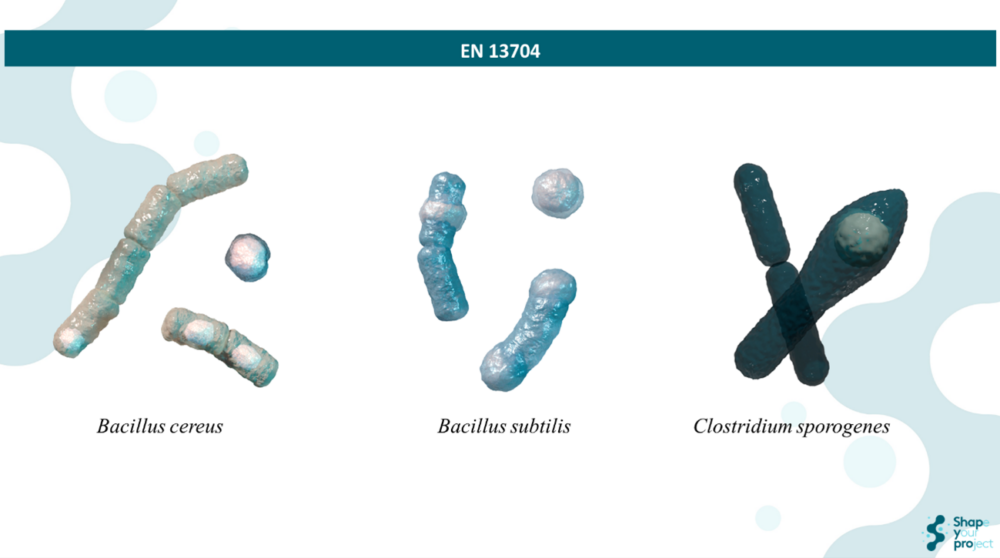
The technical content already published by SHAPYPRO reminds us that the standard uses Bacillus subtilis as the main reference organism, and that in complementary studies other microorganisms such as Bacillus cereus may also be considered in order to broaden the understanding of resistance profiles. The article itself highlights that bacterial spores are one of the most resistant biological forms and that the standard requires a robust methodological framework precisely because of this intrinsic difficulty.
This is why it makes sense to insist that recovery after contact must not become methodologically “contaminated” by the residual action of the product. The more resistant the target microorganism and the more demanding the test, the more important it becomes to ensure that the observed reduction corresponds to a real inactivation and not to a sustained inhibitory effect outside the conditions established by the method.
The importance of neutralisation in EN 13704
Within the methodological framework of EN 13704, the neutralisation phase carries much greater weight than it may seem at first glance. It is not simply a matter of stopping the action of the disinfectant after the contact time, but of ensuring that the subsequent microbiological recovery faithfully reflects the spores that actually survived. From this perspective, the analysis of the possible residual bacteriostatic effect adds an additional layer of technical interpretation, especially when the aim is to confirm that the observed reduction corresponds to a real sporicidal activity and not to an inhibition maintained outside the conditions defined by the method.
Thus, beyond the logarithmic reduction criterion or the selection of the reference microorganism, this point helps explain why the robustness of the test also depends on what happens after contact: neutralisation, recovery and counting. And that is where careful methodological execution makes the difference between a solid result and one that only looks convincing on paper.
What laboratories should be watching
From a practical point of view, laboratories working with EN 13704 should pay particular attention to several aspects:
- the selection and validation of the neutraliser;
- the absence of toxicity of the neutralisation system towards the microorganisms to be recovered;
- control of possible product carry-over into the counting phase;
- the correct execution of viability and neutralisation controls;
- and the consistency of the method across different rounds or interlaboratory comparisons.
These points are not accessories. They are part of the experimental basis that allows the laboratory to state that the observed reduction reflects sporicidal activity in accordance with the method and not a simple residual inhibitory effect. The technical description of the test on SHAPYPRO itself insists on the need for positive and negative controls and on the validation of the neutralisation step.
How SHAPYPRO can help
In this context, SHAPYPRO can help laboratories strengthen the technical interpretation of EN 13704 tests, especially in critical aspects such as correct method execution, the robustness of neutralisation and the reliability of microbiological recovery. This is particularly relevant in environments where reproducibility, comparability of results and technical evidence in audits or interlaboratory comparisons are an essential part of everyday work. In addition, SHAPYPRO already integrates EN 13704 into its technical content and its interlaboratory comparison planning, precisely because of the methodological demands involved in this standard.
Conclusion
EN 13704 does not simply require that a disinfectant reduce bacterial spores. It requires that this reduction be demonstrated through a controlled, reproducible and technically robust method. Within this logic, the residual bacteriostatic effect is not proof of efficacy, but a possible interference factor that must be controlled to avoid artificially favourable results. The value of the test depends not only on the contact between product and spore, but also on what happens afterwards: neutralisation, recovery and counting.
In other words, under EN 13704, it is not enough for the product to appear to work. It has to be demonstrated that the observed reduction corresponds to a real sporicidal activity and not to a poorly resolved methodological residue. And that difference, as often happens in microbiology, looks small until it ruins the result.