
EURACHEM 2026 will bring together international specialists in Proficiency Testing (PT), analytical chemistry, microbiology and laboratory medicine in Alicante from 28 September to 1 October 2026. SHAPYPRO will participate in the event by presenting work focused on the automation, traceability and reproducibility of Proficiency Testing analysis and reporting.
This participation provides an opportunity to share with the international community the work developed by SHAPYPRO to improve one of the key processes in any PT scheme: transforming participant results into statistical analyses and consistent, traceable and reproducible reports.
The work presented is entitled “A reproducible research approach to Proficiency Testing automated reporting and analysis” and demonstrates how data, statistical methodology, code and documentation can be connected within a single reproducible workflow.
What Is EURACHEM 2026?
The 11th Workshop on Proficiency Testing in Analytical Chemistry, Microbiology and Laboratory Medicine is organised by the Eurachem Proficiency Testing Working Group, in cooperation with CITAC and EQALM, and hosted in Alicante.
Over four days, the programme will combine specialised training, invited lectures, short technical presentations, poster sessions and working group discussions.
The aim is to provide a space for sharing experience and discussing both current practices and future directions in Proficiency Testing.
Topics included in the programme cover areas of particular relevance to PT providers and participants, such as:
- Implementation of ISO/IEC 17043.
- Basic and advanced statistics applied to PT.
- Homogeneity and stability of PT items.
- Metrological traceability of assigned values.
- Performance evaluation in qualitative and interpretative PT.
- Reporting measurement uncertainty in PT.
- Interpretation of PT reports.
- Flexible accreditation scopes for PT providers.
The programme reflects the evolution of a field in which statistics, data management, traceability and digitalisation are becoming increasingly important.
SHAPYPRO At EURACHEM 2026
SHAPYPRO will participate in the workshop with the work:
A reproducible research approach to Proficiency Testing automated reporting and analysis
The work has been developed by Emilio L. Cano and Cristina Nieves, with the participation of SHAPYPRO and the Research Centre for Intelligent Information Technologies (CETINIA-DSLAB) at Rey Juan Carlos University.
The proposal starts from a very specific challenge.
Proficiency Testing schemes generate a considerable amount of information that must go through several stages before becoming a final report:
data → validation → transformation → statistical analysis → interpretation → report
In traditional systems, some of these stages may depend on spreadsheets, manual transfer of information or independent documents.
The work presented by SHAPYPRO proposes integrating the entire process within a reproducible research environment, where the original data, transformations, statistical methods, code and final report remain connected.
What Does A Reproducible PT Report Mean?
Reproducibility means that the results of an analysis can be generated again using the same data, methods and procedures originally applied.
In a PT scheme, this is particularly important.
The final report should not simply be an independent document containing tables and conclusions.
Behind every result there are:
- Data reported by participants.
- Validation processes.
- Data transformations.
- Statistical methods.
- Calculations.
- Graphical representations.
- Performance evaluation criteria.
- Technical interpretation.
A reproducible approach keeps all these elements connected.
Therefore, if a result needs to be reviewed, a calculation checked or a report regenerated, it is possible to identify exactly which data and procedures led to each result.
The Workflow Presented By SHAPYPRO
The system presented at EURACHEM 2026 is structured according to the CRISP-DM methodology, a model used to organise data-related projects into different stages.
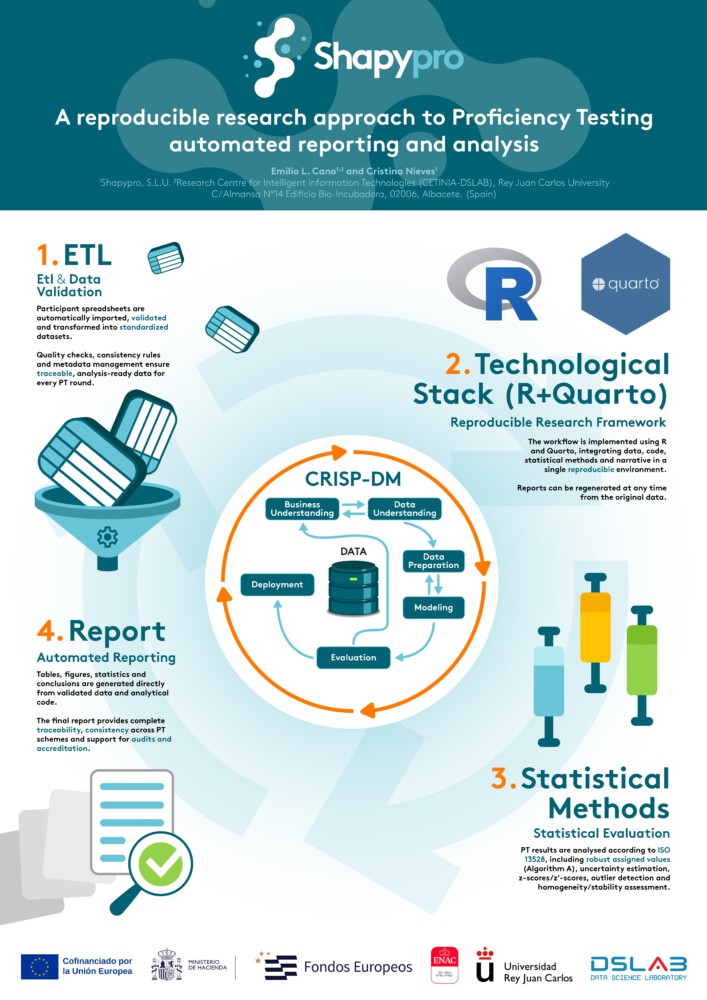
In the poster prepared for the congress, SHAPYPRO summarises the process into four main blocks:
ETL → Technology → Statistics → Report.
1. ETL And Data Validation
The first step consists of transforming the results received from participants into data ready for analysis.
Participant spreadsheets are automatically imported and undergo processes such as:
- Validation.
- Quality control.
- Consistency checks.
- Standardisation.
- Metadata management.
The ETL process — Extract, Transform, Load — makes it possible to convert different data sources into a homogeneous structure prepared for statistical analysis.
This is particularly relevant when managing different PT rounds or schemes.
Automation reduces manual tasks and helps ensure that all datasets follow the same rules before reaching the statistical stage.
2. R And Quarto As A Reproducible Environment
The workflow uses R and Quarto as its technological foundation.
R provides the environment for data processing and statistical analysis, while Quarto allows different elements to be combined within the same reproducible framework:
- Data.
- Code.
- Statistical methods.
- Tables.
- Figures.
- Narrative text.
- Results.
The main advantage is that the report is not created by manually copying results from different software tools.
Instead, it is generated directly from the data and the analytical code.
Therefore, if the data need to be reviewed or updated, the report can be regenerated using exactly the same procedure.
3. Statistical Evaluation According To ISO 13528
Statistics are an essential part of any Proficiency Testing scheme.
The system developed by SHAPYPRO integrates evaluation methods based on ISO 13528, which provides statistical methods for Proficiency Testing by interlaboratory comparison.
The work presented includes calculations and procedures such as:
- Robust assigned values.
- Algorithm A.
- Uncertainty estimation.
- z-scores.
- z’-scores.
- Outlier detection.
- Homogeneity assessment.
- Stability assessment.
The objective is not simply to automate calculations, but to ensure that they are performed in a standardised, documented and reproducible way.
4. Reports Generated Directly From The Data
The final stage is report generation.
Tables, figures, statistics and other report elements are produced directly from the validated data and analytical code.
This reduces one of the common risks associated with document-based workflows: errors caused by manually copying, modifying or transferring information.
It also provides greater consistency across different PT schemes and rounds.
The result is a system in which each report can be directly linked to:
original data → applied procedure → calculations → reported results
 From Automation To Traceability
Automating a process does not simply mean making it faster.
In a technical environment such as Proficiency Testing, one of the main benefits is improved traceability.
When data, code and results are part of the same workflow, it becomes possible to identify which transformation each data point has undergone and which procedure generated each result.
This can support:
- Internal review.
- Change control.
- Detection of possible errors.
- Audits.
- Recalculation of results.
- Comparison between different rounds.
- Long-term maintenance of the system.
The approach presented by SHAPYPRO aims to ensure that automation also contributes to greater transparency and auditability.
EURACHEM 2026 And The Evolution Of PT Schemes
The topics addressed at EURACHEM 2026 demonstrate how Proficiency Testing is evolving beyond the simple comparison of laboratory results.
The 2026 workshop includes areas such as advanced statistics, traceability of assigned values, uncertainty, qualitative evaluation, homogeneity, stability and report interpretation.
All these areas have something in common: they require structured information and sufficiently documented procedures.
As the amount of data and statistical complexity increase, so does the value of tools capable of managing the complete PT lifecycle consistently.
Digitalisation should therefore not be considered solely as a way to save time.
It can also become a tool for strengthening:
- Reproducibility.
- Traceability.
- Transparency.
- Consistency.
- Technical review.
- Long-term sustainability of processes.
ISO/IEC 17043 And ISO 13528: Two Pillars Of Proficiency Testing
The work presented at EURACHEM is also directly related to two key references for Proficiency Testing providers.
ISO/IEC 17043 establishes the general requirements for the competence and impartiality of PT providers and the consistent operation of Proficiency Testing schemes.
ISO 13528, meanwhile, provides statistical methods used for the design and analysis of Proficiency Testing by interlaboratory comparison.
The reporting system developed by SHAPYPRO connects both areas: controlled and traceable management of the PT process with the statistical evaluation of results.
This integration helps ensure that calculations are not treated as isolated elements, but as part of a complete and documented process.
What Does This Approach Offer Participants?
Although much of this work takes place within the PT provider’s own processes, the benefits also extend to participating laboratories.
A more traceable and standardised system can generate more consistent reports and facilitate interpretation of results.
Greater automation of repetitive operations also allows more time to be dedicated to tasks where technical judgement is genuinely required.
Because automating a report does not mean automating interpretation.
Expert analysis remains essential to understand results, identify particular situations and properly assess each PT round.
Technology is used to reduce manual work and improve process consistency, while technical expertise remains central to decisions that require interpretation.
An International Meeting Point For The Proficiency Testing Community
In addition to presenting this work, SHAPYPRO’s participation in EURACHEM 2026 provides an opportunity to exchange experience with PT providers, accreditation bodies, laboratories, statisticians and professionals from different analytical fields.
The workshop will bring together training activities, scientific communications, poster sessions and working groups over four days to discuss some of the main current challenges in Proficiency Testing.
This exchange is particularly valuable in a field where harmonisation, comparability and continuous improvement are themselves key objectives of Proficiency Testing.
SHAPYPRO And Continuous Improvement In Proficiency Testing
As an accredited Proficiency Testing provider, SHAPYPRO works on the development of tools aimed at improving both the management of interlaboratory comparisons and the quality of the information provided to participants.
The development of this reproducible system forms part of that process.
Integrating data validation, statistics, automation and reporting within a single environment makes it possible to move from workflows based on separate documents to systems in which all information remains connected.
And this provides something especially valuable in Proficiency Testing:
the ability to understand, review and reproduce how each result was obtained.
Conclusion
The participation of SHAPYPRO at EURACHEM 2026 will provide an opportunity to share with the international community an approach aimed at improving reproducibility, traceability and automation in Proficiency Testing schemes.
The work presented demonstrates how technologies such as R and Quarto can be integrated with statistical methods based on ISO 13528 and structured data workflows to generate reports directly connected to their analytical source.
From data to report, every stage forms part of the same process.
SHAPYPRO will be in Alicante from 28 September to 1 October 2026 to present this work, exchange experiences and continue contributing to the development of solutions that strengthen quality and confidence in Proficiency Testing.