

EN 1656 specifies a quantitative suspension test for evaluating the bactericidal activity of chemical antiseptics and disinfectants used in the veterinary area. The test determines whether a product achieves the required bacterial reduction under controlled conditions of concentration, temperature, contact time and interfering substances.
The efficacy of a disinfectant does not depend solely on its composition. The same product can produce different results depending on the concentration used, the temperature, the time it remains in contact with microorganisms and the amount of organic matter present.
For this reason, EN 1656 establishes standardized conditions that make it possible to evaluate and compare the bactericidal performance of products reproducibly.
The standard corresponds to a phase 2, step 1 test, meaning a quantitative suspension test designed to study product activity while taking into account defined conditions related to practical use.
What Is The EN 1656 Standard?
EN 1656:2019, adopted in Spain as UNE-EN 1656:2020, specifies the minimum requirements and test method for determining the bactericidal activity of chemical antiseptics and disinfectants used in the veterinary area.
The current version replaces EN 1656:2009 and was revised, among other aspects, to harmonize its structure and wording with other quantitative suspension tests developed by CEN/TC 216.
The method is designed for products that form a physically homogeneous and stable preparation when diluted with hard water or, in the case of ready-to-use products, with water.
In addition, the maximum concentration that can be evaluated using the method is 80%, because dilution always occurs during the procedure when the bacterial suspension and interfering substance are added.
Which Products Does EN 1656 Apply To?
EN 1656 focuses specifically on products used in the veterinary area.
Its applications include:
- Disinfection of equipment by immersion.
- Surface disinfection by wiping.
- Application by spraying or aerosolization.
- Disinfection by flooding or other methods.
- Teat disinfection before or after milking.
The veterinary area covered by the standard includes activities such as reproduction, breeding, animal husbandry, veterinary care facilities, transport and disposal of animals.
However, the method does not apply to the food chain once animals have been slaughtered and entered the processing industry.
It is also not intended to evaluate products for hand hygiene. To select the appropriate standards according to the intended use of the disinfectant or antiseptic, the framework established by EN 14885 should be considered.
EN 1656 Is A Phase 2, Step 1 Test
Understanding this concept helps to interpret correctly what the result demonstrates.
A phase 2, step 1 test is performed in suspension under carefully controlled laboratory conditions.
The microorganism is therefore suspended in a liquid medium together with a substance that simulates defined conditions of use and is subsequently brought into contact with the product.
The test makes it possible to determine the intrinsic activity of the product under the selected conditions.
However, it does not by itself reproduce all the variables present on a real surface, piece of equipment or installation.
For this reason, within a complete efficacy assessment strategy, EN 1656 should be interpreted according to the intended use of the product and together with the other applicable standards.
What Reduction Does EN 1656 Require?
The fundamental requirement is clear:
the product must demonstrate a bacterial reduction of at least 5 log.
A 5 log reduction means reducing the bacterial population by a factor of 100,000, equivalent to approximately 99.999%.
The reduction is calculated by comparing the initial number of microorganisms present at the start of the contact time with the number of bacteria surviving after exposure to the product.
In simplified form:
Logarithmic reduction = log N₀ − log Nₐ
where:
- N₀ represents the bacterial concentration at the beginning of the contact time.
- Nₐ represents the number of bacteria surviving after treatment.
For a concentration to be considered bactericidal under the tested conditions, a reduction equal to or greater than 5 log must be obtained.
Test Microorganisms According To EN 1656
The microorganisms used depend on the intended application of the product.
General Disinfection In The Veterinary Area
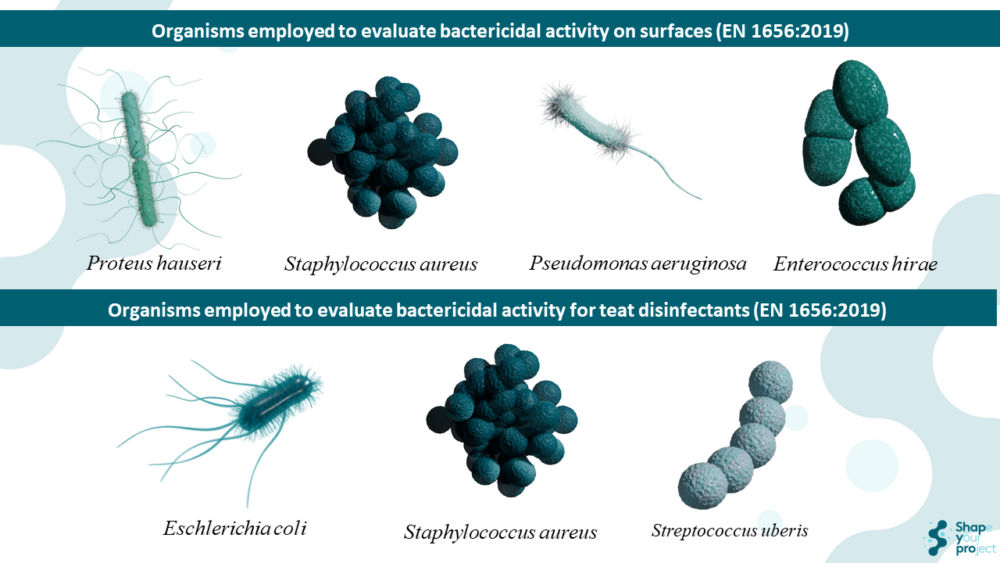
For products intended for general disinfection, the standard specifies the following minimum test microorganisms:
- Enterococcus hirae ATCC 10541.
- Proteus hauseri ATCC 13315.
- Pseudomonas aeruginosa ATCC 15442.
- Staphylococcus aureus ATCC 6538.
Proteus hauseri was previously identified as Proteus vulgaris.
Teat Disinfectants
For products specifically intended for teat disinfection, the following microorganisms are used:
- Escherichia coli ATCC 10536.
- Staphylococcus aureus ATCC 6538.
- Streptococcus uberis ATCC 19436.
Additional microorganisms may also be included when they are relevant to the specific conditions of use of the product.
This distinction is important because the standard does not evaluate all veterinary disinfectants using a single set of microorganisms.
Test Conditions In EN 1656
One of the most relevant aspects of EN 1656 is that a 5 log reduction cannot be interpreted in isolation.
The result is always associated with specific experimental conditions.
The main variables include:
- Product concentration.
- Temperature.
- Contact time.
- Microorganism.
- Interfering substance.
- Simulated soiling condition.
Therefore, simply stating that a product “complies with EN 1656” provides less information than indicating the concentration, temperature, contact time and conditions under which it has demonstrated bactericidal activity.
Temperature And Contact Time
For products intended for surface disinfection in the veterinary area, the standard allows temperatures between 5 °C and 40 °C, in 5 °C intervals.
The contact time may be selected according to the intended use, within the limits established by the method:
- Minimum: 1 minute.
- Maximum: 120 minutes.
Different conditions apply to teat disinfection.
After Milking
The contact time may range between:
- Minimum: 1 minute.
- Maximum: 30 minutes.
Before Milking
Shorter contact times apply:
- Minimum: 30 seconds.
- Maximum: 3 minutes.
In addition, the specified temperatures for teat disinfectants are between 20 °C and 30 °C.
These differences allow the test to be adapted to different veterinary use scenarios.
Organic Matter Can Change Disinfectant Efficacy
Under real conditions, disinfectants rarely act on a completely clean surface.
Proteins, organic residues, secretions and other materials can reduce the availability of certain active substances and, consequently, decrease product efficacy.
To take this variable into account, EN 1656 uses interfering substances.
Low-Level Soiling Conditions
For general disinfection, the following may be used:
3.0 g/l bovine albumin.
High-Level Soiling Conditions
The standard specifies a combination of:
10 g/l bovine albumin + 10 g/l yeast extract.
Other relevant substances may also be selected when necessary to reproduce particular conditions of use.
Specific Conditions For Teat Disinfectants
The interfering substance used also changes for products intended for teat disinfection.
Before milking:
3.0 g/l bovine albumin.
After milking:
10.0 g/l milk powder.
This distinction is intended to represent more accurately the conditions the disinfectant may encounter during use.
Therefore, the evaluation of a product intended specifically for this application should take these particular conditions into account.
How Is The EN 1656 Test Performed?
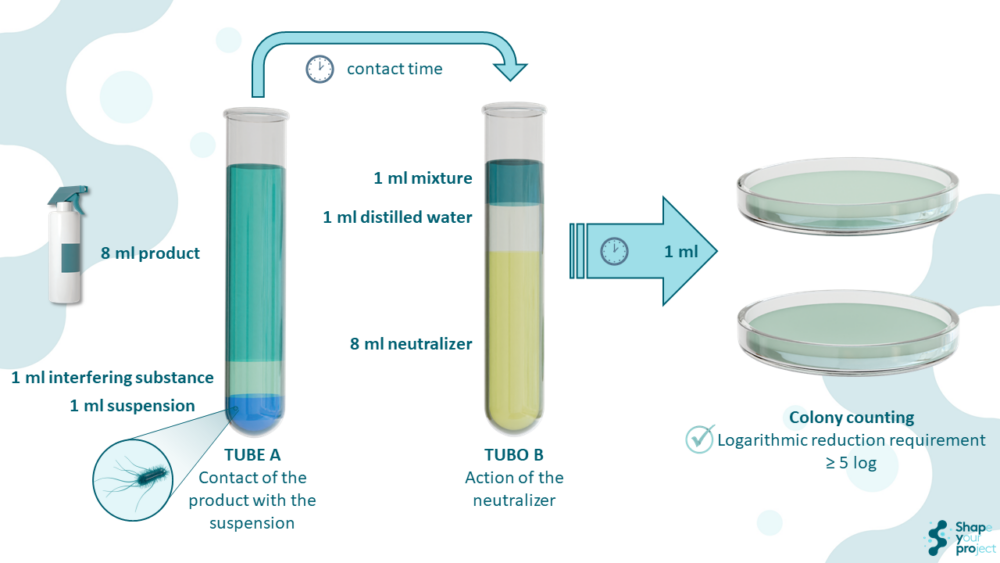
The principle of the method can be summarized in several stages.
- Preparation Of The Bacterial Suspension
A standardized suspension of the corresponding microorganism is prepared.
The initial test suspension should contain between:
1.5 × 10⁸ and 5 × 10⁸ CFU/ml.
A separate validation suspension is also prepared to verify that the method performs correctly.
- Addition Of The Interfering Substance
The bacterial suspension is mixed with the interfering substance corresponding to the conditions to be simulated.
This mixture is maintained for a preliminary period of 2 minutes before adding the disinfectant.
- Exposure To The Product
The product solution is then added at the selected concentration.
The mixture is maintained at the specified temperature for the defined contact time.
- Stopping The Disinfectant Activity
Once the contact time has ended, the bactericidal activity must be stopped immediately.
The preferred EN 1656 method is dilution-neutralization.
If a suitable neutralizer cannot be found, membrane filtration may be used as an alternative.
- Counting The Surviving Bacteria
After neutralizing or removing the residual activity of the product, the surviving bacteria are counted.
Finally, the result is compared with the initial population to calculate the logarithmic reduction achieved.
Neutralization Is Essential For A Valid Result
Correctly neutralizing the disinfectant is a critical part of the test.
If product activity continues after the contact time has ended, bacteria may continue to be inactivated during sample preparation and counting.
In that case, the result could indicate greater efficacy than was actually achieved during the specified contact time.
For this reason, EN 1656 requires neutralization to be validated for:
- The product being evaluated.
- The highest concentration used.
- Each microorganism.
- Each selected experimental condition.
In addition, the neutralizer itself must not exert a significant toxic effect on the bacteria.
The standard includes specific controls to demonstrate both the absence of adverse effects from the neutralizer and the efficacy of the procedure used.
Dilution-Neutralization Or Membrane Filtration
The standard establishes dilution-neutralization as the preferred method.
In this procedure, once the contact time has ended, an aliquot of the mixture is transferred immediately to a neutralizer capable of stopping residual antimicrobial activity.
However, not all products can be adequately neutralized using this procedure.
When a valid neutralizer cannot be found, the membrane filtration method may be used.
In this case, the bacteria are retained on a 0.45 μm membrane and the product is removed using a validated rinsing procedure.
Regardless of the method used, it must be demonstrated that the procedure allows the surviving microorganisms to be recovered correctly.
The Importance Of Controls And Validation
A reduction result ≥ 5 log is not sufficient on its own for the test to be considered valid.
EN 1656 includes controls designed to demonstrate that the experimental conditions and the analytical procedure itself do not distort the result.
These include:
Control A — Experimental Conditions
Verifies that the conditions used do not themselves cause a significant reduction in the bacterial population.
Control B — Neutralizer Or Filtration
Verifies that the neutralizer or filtration procedure does not adversely affect recovery of the microorganisms.
Control C — Method Validation
Demonstrates that the system used successfully stops or removes the antimicrobial activity of the product.
Only when the requirements established for these controls are met can the test be considered valid.
Testing A Single Concentration Is Not Enough
Another important aspect of EN 1656 is that the product test solutions should be prepared at a minimum of three different concentrations.
The aim is to include both:
- A concentration within the active range.
- A concentration within the inactive range.
In fact, for the test to determine product activity appropriately, at least one concentration must achieve a reduction ≥ 5 log and at least one concentration must show a reduction < 5 log.
This makes it possible to identify the bactericidal concentration of the product more accurately under the selected conditions.
What Is The Limiting Test Organism?
Not all bacteria necessarily show the same susceptibility to a disinfectant.
For this reason, EN 1656 determines, for each microorganism, the lowest product concentration capable of achieving a reduction of at least 5 log.
The limiting test organism is the microorganism that requires the highest concentration to achieve this result.
In other words, it is the least susceptible strain to the product under the selected experimental conditions.
The active concentration against this microorganism is used to establish the bactericidal concentration determined according to EN 1656.
This concept is important because it prevents the conclusion from being based only on the bacterium most susceptible to the product.
When Does A Product Comply With EN 1656?
For products intended for general disinfection of veterinary surfaces, the test is considered satisfactory when a valid test demonstrates a reduction ≥ 5 log against:
- Enterococcus hirae.
- Proteus hauseri.
- Pseudomonas aeruginosa.
- Staphylococcus aureus.
The result must be obtained at the selected temperature, contact time, concentration and interfering substance.
For teat disinfectants, the same minimum reduction requirement must be demonstrated against:
- Escherichia coli.
- Staphylococcus aureus.
- Streptococcus uberis.
In addition, the conditions corresponding to use before or after milking must be applied.
Therefore, the final result should clearly state under which conditions the product demonstrates bactericidal activity.
EN 1656 And Proficiency Testing
Correctly applying a standardized method does not depend solely on having access to the technical document.
The preparation of suspensions, control of bacterial concentrations, selection and validation of the neutralizer, exact compliance with contact times and microbiological counting can all introduce variability between laboratories.
For this reason, Proficiency Testing Programs (PT) allow the performance of different laboratories applying the same method to be compared.
Participation in proficiency testing can help to:
- Evaluate the technical performance of the laboratory.
- Compare results with other participants.
- Detect methodological deviations.
- Identify potential systematic problems.
- Provide objective evidence on the validity of results.
- Strengthen continuous improvement processes.
EN 1656 establishes how the bactericidal test should be performed; PT programs make it possible to evaluate how each laboratory is applying that method.
This distinction is important to avoid confusing the purpose of the standard with that of an interlaboratory comparison.
If your laboratory performs testing related to disinfectants and antiseptics, you can check the upcoming SAHPYPRO Proficiency Testing Programs and review the available dates to register: https://shapypro.com/upcoming-proficiency-testing-programs/
EN 1656 And EN 14885: How Are They Related?
EN 14885 provides the general framework for selecting and applying European standards intended to demonstrate the efficacy of chemical antiseptics and disinfectants.
Within this system, EN 1656 provides a specific method for evaluating bactericidal activity in the veterinary area using a phase 2, step 1 quantitative suspension test.
Therefore, the set of tests required to support the efficacy claims of a product should be selected taking into account:
- The area of application.
- The intended use.
- The microorganisms against which activity is claimed.
- The method of application.
- The actual conditions of use.
EN 1656 therefore forms part of a broader efficacy assessment strategy and should not be interpreted in isolation.
EN 1656 Proficiency Testing With SHAPYPRO
At SHAPYPRO, we develop Proficiency Testing Programs related to standardized methods for evaluating the efficacy of chemical antiseptics and disinfectants.
Interlaboratory comparisons allow laboratories to assess their performance in critical aspects of methods such as EN 1656 and compare their results with those obtained by other participants.
In addition, these programs provide objective information that can be used within quality management systems and laboratory continuous improvement processes.
Correct application of EN 1656 requires the control of numerous experimental variables. For this reason, assessing performance through interlaboratory comparisons is an especially useful tool for laboratories working in disinfectant efficacy testing.
Conclusion
EN 1656 establishes a standardized method for evaluating the bactericidal activity of chemical antiseptics and disinfectants used in the veterinary area.
The minimum 5 log reduction criterion is one of its essential elements, but it is not the only one.
Microorganisms, concentration, temperature, contact time, interfering substances, neutralization and validation controls all form part of the result and should be interpreted together.
The distinction between products intended for general disinfection and products intended for teat disinfection also makes it possible to adapt the experimental conditions to different veterinary applications.
Correctly applying all these parameters makes it possible to obtain reproducible and comparable results. In addition, participation in Proficiency Testing Programs can help laboratories verify their performance and detect potential deviations in the application of the method.