


The ISO 11930 Challenge Test is the reference method for evaluating the preservation efficacy of a cosmetic formulation and determining, together with the microbiological risk assessment, whether the product provides adequate antimicrobial protection. The standard does not simply assess whether a preservative works: it considers the antimicrobial protection of the product as a whole, taking into account the formulation itself, the preservation system, the manufacturing process and the characteristics of the packaging.
ISO 11930 establishes a standardized procedure in which a cosmetic formulation is subjected to controlled microbial contamination and the evolution of the microorganisms is monitored over a period of 28 days.
The results make it possible to determine whether the formulation meets the criteria established by the standard and how these results should be interpreted as part of the overall microbiological risk assessment of the cosmetic product.
What Is The ISO 11930 Challenge Test?
ISO 11930:2019, Cosmetics — Microbiology — Evaluation of the antimicrobial protection of a cosmetic product, establishes a reference method for evaluating the preservation of a cosmetic formulation.
The principle of the test is to expose the product separately to standardized inocula of different microorganisms.
The number of surviving microorganisms is then determined at defined intervals and the logarithmic reduction is calculated in relation to the initial microbial population.
The behaviour of each microorganism is compared with the acceptance criteria established by the standard.
However, ISO 11930 goes beyond the preservation efficacy test itself.
The antimicrobial protection of a cosmetic product may result from different factors, including:
- Chemical protection provided by the preservation system.
- Intrinsic characteristics of the formulation.
- The manufacturing process.
- The design and performance of the packaging.
For this reason, the Challenge Test result should be interpreted as part of the overall antimicrobial protection assessment of the finished cosmetic product.
Do All Cosmetic Products Require A Challenge Test?
Not necessarily.
This is an important aspect of ISO 11930 because the preservation efficacy test should not be considered an identical requirement for every type of cosmetic product.
The standard states that the test does not apply to products whose microbiological risk has been demonstrated to be low, following the risk assessment approach described in ISO 29621.
Certain characteristics of a formulation or finished product may inherently limit microbial growth.
Factors that may be relevant to the microbiological risk assessment include:
- Water activity.
- pH.
- Characteristics of the formulation.
- Ingredients that contribute to antimicrobial protection.
- Manufacturing conditions.
- Packaging system.
- Expected conditions of use.
Therefore, the microbiological characteristics of the product should be evaluated before determining the appropriate testing strategy.
When a cosmetic product cannot be demonstrated to have a low microbiological risk, the ISO 11930 Challenge Test provides the reference method for evaluating preservation efficacy.
Microorganisms Used In The ISO 11930 Challenge Test
ISO 11930 specifies five reference microorganisms representing different types of microbial contamination:
- Pseudomonas aeruginosa ATCC 9027.
- Staphylococcus aureus ATCC 6538.
- Escherichia coli ATCC 8739.
- Candida albicans ATCC 10231.
- Aspergillus brasiliensis ATCC 16404.
The first three are bacteria, while Candida albicans is a yeast and Aspergillus brasiliensis is a mould.
Each microorganism is tested separately so that the ability of the formulation to control its survival can be evaluated individually.
Standardization of the strains, growth conditions and inoculum preparation is essential to improve the reproducibility of the test.

Before Testing: Why Neutralization Is Essential
One of the most important technical aspects of the Challenge Test is the neutralization of the antimicrobial activity of the formulation.
Before preservation efficacy can be evaluated, the laboratory must demonstrate that the analytical procedure sufficiently neutralizes the antimicrobial properties of the product during microbial recovery.
Why is this so important?
If the preservative system continues to act after the sample has been collected for analysis, microorganisms may continue to be inactivated during the counting procedure.
This could produce an artificially low microbial count and make the formulation appear more effective than it actually is.
ISO 11930 therefore requires the efficacy of the neutralization procedure to be demonstrated for the formulation and the test strains used.
The standard considers the neutralization effective when the required recovery conditions are met. If the initial approach is insufficient, different strategies can be investigated, including:
- Modifying the neutralizer.
- Increasing the dilution of the sample.
- Using another suitable neutralization procedure.
- Applying membrane filtration where appropriate.
Neutralization is therefore not a minor preliminary step: it is essential for ensuring that the subsequent microbial counts can be interpreted correctly.
How Is The ISO 11930 Challenge Test Performed?
The preservation efficacy test is carried out separately for each microorganism.
Before starting, the microbiological quality of the test product should also be determined to ensure that microorganisms already present in the sample do not interfere with recovery of the test organisms.
- Sample Preparation
A defined amount of the formulation is placed in a separate sterile container for each test strain.
- Inoculation
Each sample is inoculated with a standardized suspension of the corresponding microorganism.
The final target concentrations in the formulation are:
| Microorganism | Initial Concentration In The Formulation |
| Bacteria | 1 × 10⁵ to 1 × 10⁶ CFU/ml or g |
| Candida albicans | 1 × 10⁴ to 1 × 10⁵ CFU/ml or g |
| Aspergillus brasiliensis | 1 × 10⁴ to 1 × 10⁵ CFU/ml or g |
The inoculum should be thoroughly distributed throughout the sample.
- Incubation
The inoculated formulations are maintained at 22.5 ± 2.5 °C during the test period.
- Sampling
Microbial counts are performed at the time points specified by the standard.
Depending on the microorganism and the evaluation criterion, these include:
- Day 7 (T7).
- Day 14 (T14).
- Day 28 (T28).
- Counting Surviving Microorganisms
At each sampling point, the antimicrobial activity of the formulation is neutralized and the number of surviving microorganisms is determined.
- Calculating Logarithmic Reduction
Preservation efficacy is expressed through the logarithmic reduction obtained in relation to the initial microbial population.
The reduction is calculated by comparing the initial microbial concentration with the number of microorganisms surviving at each sampling time.
A greater reduction indicates a greater decrease in the microbial population.
However, the final interpretation depends on the specific requirements established for each microorganism and sampling time.
Criteria A And B In The ISO 11930 Challenge Test
ISO 11930 establishes two evaluation criteria: Criterion A and Criterion B.
Understanding the difference between them is essential when interpreting a Challenge Test report.
Criterion A
Criterion A demonstrates that the formulation itself provides sufficient protection against microbial proliferation that could represent a potential risk to the user.
When all microorganisms comply with Criterion A, the formulation satisfies the preservation efficacy requirements without the need for additional factors to justify its antimicrobial protection.
Criterion B
Criterion B requires a different interpretation.
A formulation meeting Criterion B may provide an acceptable level of protection when the microbiological risk assessment demonstrates the existence of additional control factors that are not related to the formulation itself.
Packaging can be one of these factors.
For example, a dispensing system that limits direct contact between the consumer and the product may reduce the probability of contamination during use.
Therefore, meeting Criterion B does not automatically mean that the Challenge Test has failed.
It means that additional information is required to demonstrate that the overall microbiological risk of the finished product remains tolerable.
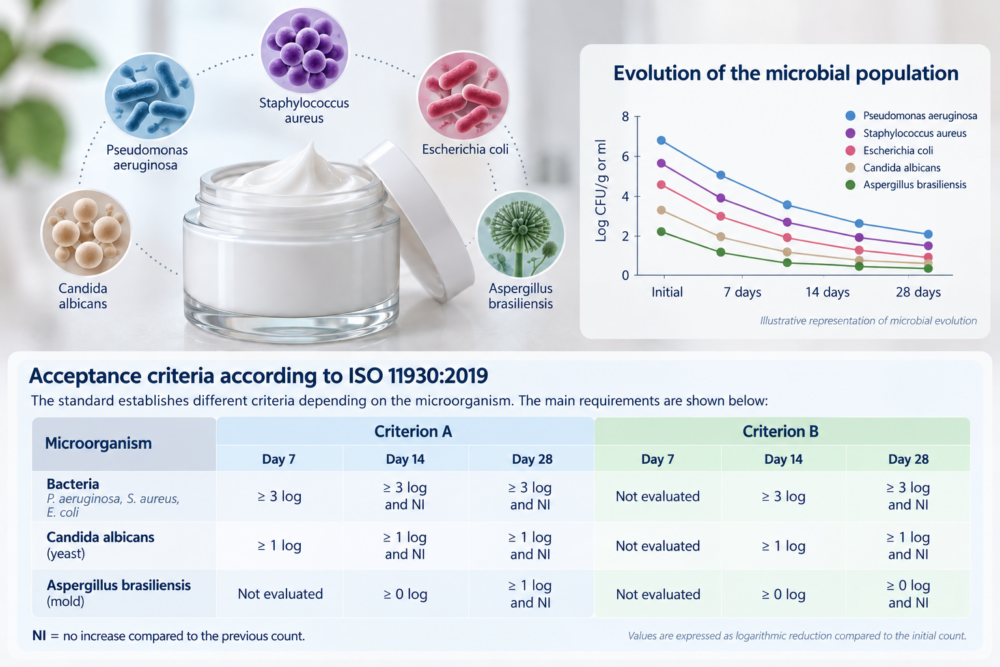
Acceptance Criteria According To ISO 11930
The criteria are based on logarithmic reductions and, at certain time points, the absence of any subsequent increase in the microbial population.
NI means no increase compared with the previous contact time.
| Microorganism | Criterion | T7 | T14 | T28 |
| Bacteria | A | ≥ 3 log | ≥ 3 log and NI | ≥ 3 log and NI |
| Bacteria | B | Not evaluated | ≥ 3 log | ≥ 3 log and NI |
| C. albicans | A | ≥ 1 log | ≥ 1 log and NI | ≥ 1 log and NI |
| C. albicans | B | Not evaluated | ≥ 1 log | ≥ 1 log and NI |
| A. brasiliensis | A | Not evaluated | ≥ 0 log | ≥ 1 log and NI |
| A. brasiliensis | B | Not evaluated | ≥ 0 log | ≥ 0 log and NI |
ISO 11930 also takes into account the inherent variability associated with microbiological counts. The standard considers a deviation of 0.5 log units acceptable when the calculated reductions are compared with the predefined criteria.
What Does Compliance With Criterion A Mean?
When the logarithmic reductions obtained for all microorganisms comply with Criterion A, the formulation meets the Criterion A requirements of the preservation efficacy test.
In this situation, the preservation capacity of the formulation itself is considered sufficient against the microbial proliferation evaluated by the method.
No additional control factors are required to justify compliance with the antimicrobial protection requirements considered by ISO 11930.
What Does Compliance With Criterion B Mean?
Criterion B should not be interpreted in exactly the same way as Criterion A.
If the formulation only meets Criterion B, the microbiological risk assessment should demonstrate that additional control factors exist outside the formulation and sufficiently reduce the microbiological risk.
One of these factors may be the packaging.
Consequently, the Challenge Test result should not simply be reported as “pass” or “fail” without considering which criterion has been achieved and how the finished product is intended to be used.
Understanding the criterion achieved by the formulation and the additional characteristics of the finished product provides a much more meaningful assessment of antimicrobial protection.
Packaging Also Influences Antimicrobial Protection
ISO 11930 specifically highlights the role of packaging in the overall antimicrobial risk assessment.
The probability of contamination during use is not the same for a cream packaged in a wide-mouth jar as it is for a product dispensed through a pump or a system designed to prevent direct consumer contact with the bulk product.
Factors considered when assessing packaging-related risk include:
- Single-use or multi-use packaging.
- Pack size.
- Product dispensing method.
- Expected duration of use.
- Possibility of direct consumer contact with the product.
- Protective dispensing systems.
- Pressurized packaging.
- Additional applicators such as brushes, pads or puffs.
For example, packaging incorporating a one-way valve or another protective dispensing mechanism may reduce the probability of contamination during normal use.
Conversely, a large multi-use container that allows repeated direct contact with the product can increase exposure to microbial contamination.
This is one reason why the Challenge Test result should ultimately be interpreted in relation to the finished cosmetic product, not only the formulation in isolation.
What Happens If Criteria A Or B Are Not Met?
If one or more microorganisms fail to meet either Criterion A or Criterion B, the formulation does not satisfy the preservation efficacy test requirements.
However, ISO 11930 distinguishes between the outcome of the test performed on the formulation and the overall antimicrobial protection of the finished cosmetic product.
In this situation, the status of the product should be evaluated through microbiological risk assessment.
Additional product characteristics may provide significant risk reduction.
For example, a product supplied in single-use units can considerably limit the opportunities for microbial contamination after opening.
If the risk assessment demonstrates that sufficiently robust additional control factors are present and the microbiological risk is tolerable, these factors should be appropriately justified and documented.
If the required level of protection cannot be demonstrated, the product does not satisfy the antimicrobial protection requirements of the standard.
Challenge Test And Microbiological Control Are Not The Same
The Challenge Test and routine microbiological control answer different questions.
Microbiological control evaluates the microbial load present in a sample and can determine the presence or absence of specified microorganisms.
The Challenge Test, on the other hand, intentionally introduces microorganisms into the formulation to determine how effectively its preservation system controls them over time.
Therefore, obtaining satisfactory microbiological quality results for a finished sample does not in itself demonstrate that the formulation will be capable of controlling contamination that could occur later during use.
Both evaluations provide different and complementary information about the microbiological quality and safety of a cosmetic product.
This relationship can also be explored in SAHPYPRO’s content on microbiological control in cosmetic products.
ISO 11930 Challenge Test And The CPSR
Preservation efficacy is also relevant to the safety assessment of cosmetic products.
When applicable, the results of the Challenge Test contribute to the microbiological information considered when preparing the Cosmetic Product Safety Report (CPSR).
The result should therefore be interpreted together with other information relating to the formulation and finished product, including:
- Microbiological quality.
- Stability.
- Packaging.
- Manufacturing conditions.
- Intended use.
- Target population.
- Other relevant safety data.
The Challenge Test does not replace a complete cosmetic safety assessment. Instead, it provides specific evidence regarding the ability of the product to withstand microbial contamination.
SAHPYPRO also addresses preservation efficacy as part of the microbiological and safety information considered in the CPSR.
Current Status Of ISO 11930
ISO 11930:2019 remains the published edition of the standard and is supplemented by ISO 11930:2019/Amd 1:2022.
ISO is currently developing a third edition under ISO/CD 11930. As of September 2026, the project is at Committee Draft stage and is intended to replace ISO 11930:2019 once the revision process is completed and the new edition is formally published.
Therefore, laboratories and cosmetic manufacturers should continue to follow developments in the standard and review their procedures when a new edition is officially published.
ISO 11930 Challenge Test With SAHPYPRO
At SAHPYPRO, we perform Challenge Tests to evaluate the efficacy of preservation systems used in cosmetic products.
The test provides information on how a formulation responds to controlled microbial contamination and allows its performance to be assessed according to the applicable evaluation criteria.
This information can be integrated with other studies related to cosmetic product quality and safety, including:
- Microbiological control.
- Stability studies.
- Packaging compatibility assessments.
- Cosmetic Product Safety Report (CPSR).
- Regulatory support.
Combining these evaluations during product development can help identify microbiological weaknesses before commercialization and support informed decisions regarding the formulation, preservation system or packaging.
Conclusion
The ISO 11930 Challenge Test is much more than a simple test of whether a preservative works.
The standard provides a reference method for studying the response of a cosmetic formulation to defined microorganisms and establishes specific criteria for interpreting preservation efficacy.
It also places those results within the wider assessment of the antimicrobial protection of the finished product.
The distinction between Criteria A and B, neutralization efficacy, microbial behaviour, microbiological risk and packaging characteristics are all important when interpreting the final result.
Considering these elements together provides a more complete understanding of the microbiological protection of a cosmetic product and generates technical evidence to support its development, safety assessment and commercialization.